
Una pausa del comfort
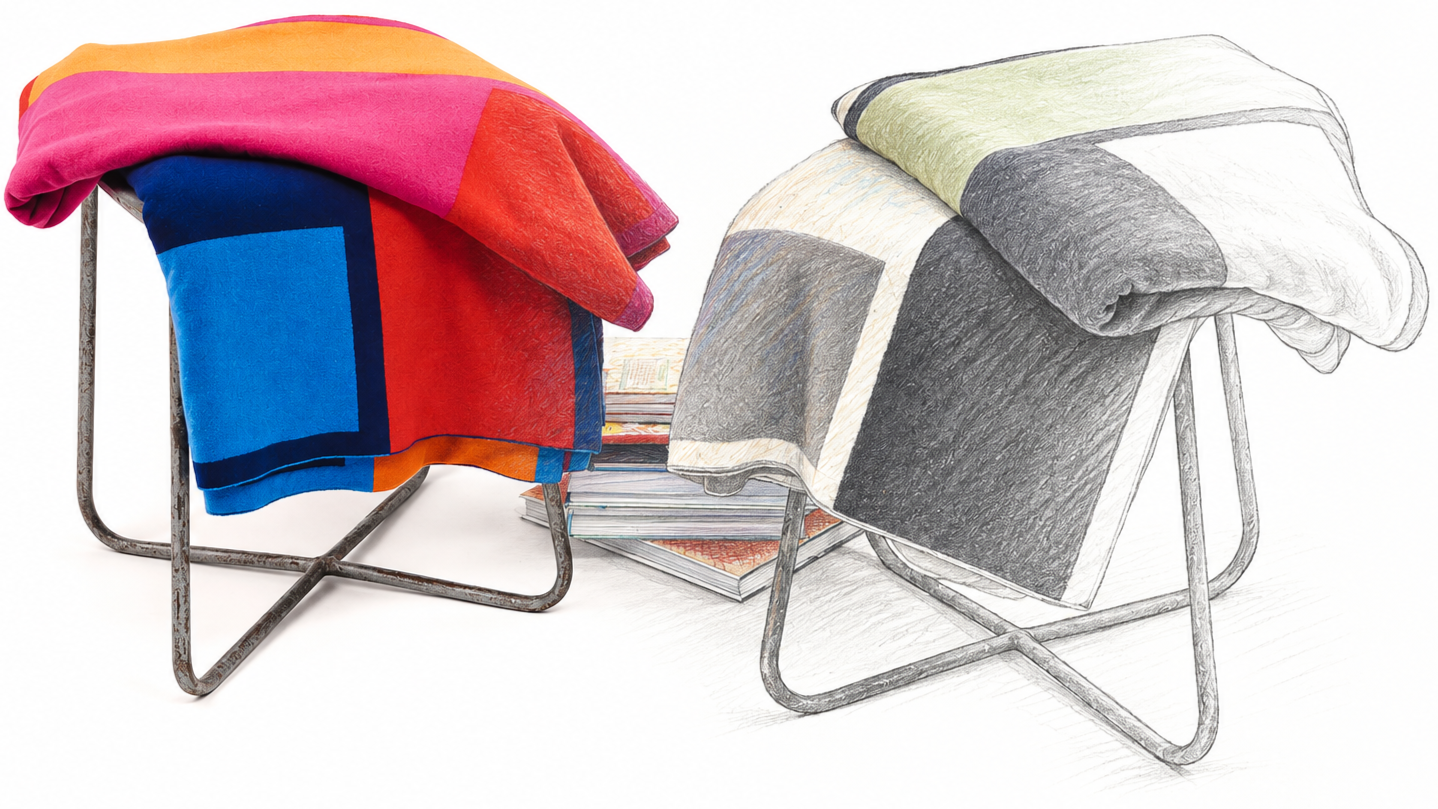
Blanket ‘Segment of frame’ in merino cardata wool, jacquard double 4 colors
Non parlo di tendenze ma di armonie che restano, di dettagli che fanno la differenza e di quella misura invisibile che distingue il fatto bene dal semplice bello.
II linguaggio della maglia nella casa, come materia per l'abitare:
• perché la maglia non rappresenta solo l'abbigliamento
• il valore della struttura tridimensionale • la relazione tra tatto, luce e volume
• Il tessuto in maglia è capace di creare volume, morbidezza e ritmo nello spazi domestico. E' una superficie fatta di anelli che si intrecciano e creano volume, elasticità e profondità. Porta con sé una qualità diversa rispetto ai tessuti tradizionali.
La maglia nella casa: 6 principi per una materia che accoglie
1. La materia prima è il tatto Dopo lo sguardo, un oggetto per la casa parla anche attraverso la mano. La qualità della fibra, la morbidezza, e la densità della superficie creano una relazione con chi abita lo spazio. Una materia che invita al contatto.
2. La struttura genera forma La maglia non è un tessuto statico, è una costruzione fatta di anelli che si concatena-no e creano una superficie viva. La forma nasce dalla struttura stessa della maglia.
3. La tridimensionalità crea profondità Negli interni contemporanei molte superfici sono lisce e uniformi. La maglia introdu-ce un ritmo diverso: rilievi, micro-variazioni che rendono la superficie più ricca. E una tridimensionalità discreta.
4. La morbidezza equilibra lo spazio Legno, metallo, pietra e vetro danno solidità agli ambienti. La maglia porta l'elemento complementare: una morbidezza strutturata con i diversi materiali rigidi. Questo equilibrio è ciò che rende uno spazio accogliente.
5. Il tempo come criterio progettuale Un oggetto per la casa non dovrebbe esistere per una stagione. La scelta dei materiali, della struttura e del colore dovrebbe permettere all'oggetto di restare nello spazio-tempo, senza diventare estraneo. La durata è parte del progetto.
6. La presenza silenziosa Gli oggetti migliori non dominano l'ambiente. Sono presenze discrete che si integra-no nello spazio e diventano naturali nella vita quotidiana.
A moment of comfort
I’m not talking about trends, but about harmonies that endure, details that make all the difference, and that intangible quality that sets ‘well-made’ apart from merely ‘beautiful’.
The language of knitwear in the home, as a material for living:
• because a jumper is not just a piece of clothing
• the significance of three-dimensional form • the relationship between touch, light and volume
• Knitted fabric has the ability to create volume, softness and rhythm within the home. It is a surface made up of interlocking loops that create volume, elasticity and depth. It offers a different quality to traditional fabrics.
LKnitting at home: 6 principles for a cosy atmosphere
1. The raw material is touch After the eye, a home accessory also speaks through the hand. The quality of the fibre, its softness and the density of the surface create a connection with those who live in the space. A material that invites touch.
2. Structure gives rise to form Knitwear is not a static fabric; it is a construction made up of loops that link together to create a living surface. Form arises from the very structure of the knit.
3. Three-dimensionality creates depth In contemporary interiors, many surfaces are smooth and uniform. The knit introduces a different rhythm: textures and subtle variations that enrich the surface. It is a subtle three-dimensionality.
4. Softness brings balance to a space Wood, metal, stone and glass lend a sense of solidity to rooms. Knitwear provides the complementary element: a softness that contrasts with the various rigid materials. It is this balance that makes a space welcoming.
5. Time as a design criterion A household object should not be designed to last just one season. The choice of materials, structure and colour should enable the object to remain within the space-time continuum without feeling out of place. Durability is part of the design.
6. The silent presence The best objects do not dominate their surroundings. They are unobtrusive presences that blend into the space and become a natural part of everyday life.
